Security Deposit Laws by State: A Landlord's Guide (2026)
Security deposits are the single most common reason landlords end up in court. Not because the rules are unfair, but because the rules are different in every state and most landlords learn them the hard way.
Disclaimer: This guide is general information for landlords, not legal advice. Security deposit laws vary by state and are amended frequently. Always check your state's current statute or talk to a local landlord-tenant attorney before making decisions involving deductions, withholding, or disputes.
If you ask any landlord-tenant attorney what the most common case they handle is, the answer is the security deposit. Not eviction. Not lease violations. Not even non-payment of rent. The security deposit case, usually because a landlord missed a deadline, didn't itemize deductions, or kept the deposit for something that wasn't legally deductible.
The frustrating part is that none of these are hard rules to follow. They're just different in every state, and most landlords assume the rules in their state are the rules everywhere. They aren't.
This guide walks through the framework that's true everywhere, then gives you a state-by-state quick reference for the four numbers that matter most: deposit limit, return deadline, interest requirement, and where the money has to be held. If you manage rentals in more than one state, treat each one as a separate playbook.
What is a security deposit and what is it actually for?
A security deposit is money the tenant pays at lease signing that the landlord holds, but does not own, for the duration of the tenancy. It's collateral against three specific things, and only these three:
- Unpaid rent at the end of the lease
- Damage beyond normal wear and tear
- Cleaning costs to return the unit to its pre-tenancy condition
That's it. Security deposits are not a "non-refundable cleaning fee" (illegal in most states even with a lease clause), not a buffer against future increases, and not a slush fund the landlord can dip into during the lease.
The deposit belongs to the tenant. The landlord is a custodian of those funds, and in some states a fiduciary, until move-out. Misunderstanding this single legal concept is the root cause of most security deposit disputes.

How much can a landlord charge for a security deposit?
Limits range from "no cap" to "one month's rent maximum." The general categories:
- No cap (about 12 states): Texas, Florida, Pennsylvania, Indiana, Michigan, Colorado (no statutory cap), Georgia, and others. You can charge whatever the market accepts, but you still owe full statutory protections (separate accounts, return deadlines).
- 1 month's rent (about 8 states): California (limited to 1 month for most unfurnished units as of 2024, significantly tighter than older rules), Delaware (1x rent for leases under 1 year), New York (1 month max).
- 1.5 to 2 months of rent: Connecticut, Illinois, Maine, Massachusetts, New Jersey, Pennsylvania (under some conditions).
- 2 to 3 months of rent for furnished units: Many states allow extra deposit for furnished rentals.
- Pet deposits separate or included: Some states cap the total deposit including pets. Others allow a separate pet deposit on top.
Practical rule: if you're charging more than 1 month of rent, look up your state's specific cap before you sign the lease. If you exceed it, courts will typically order you to return the excess plus damages, and in some states the entire deposit becomes refundable on demand.
When must a landlord return a security deposit?
This is where landlords lose the most. The return deadline is a hard date. Miss it by one day and you typically forfeit the entire deposit, regardless of legitimate damage.
| Deadline range | Example states |
|---|---|
| 14 days | Vermont |
| 15 days | Arizona |
| 21 days | California, Connecticut, Wisconsin |
| 30 days | Most common: Texas, Florida, Illinois, Massachusetts, New York, Pennsylvania, Washington, Virginia |
| 45 days | New Jersey, Delaware, Indiana |
| 60 days | Arkansas, Maryland, Tennessee |
The clock starts on the date of move-out, not the lease end date. If the tenant moves out three days early and returns the keys, your countdown begins that day.
If you're going to deduct anything, that itemized statement must be sent within the same deadline. You don't get extra time to do the accounting.
If you can't get an exact damage estimate by the deadline (for example, you have a contractor coming next week), most states let you send a partial return plus a written notice that the rest will be itemized within a follow-up window. The rules are state-specific, though. Don't improvise.
Do landlords have to pay interest on security deposits?
About 16 states require interest, with rates and rules that vary widely:
- Annual interest at a fixed rate: Connecticut (varies), Illinois (depending on building size), Massachusetts (5% or actual bank rate, whichever is less), Maryland (1.5% or actual rate).
- Interest at the bank's actual rate: Florida (in some cases), New Jersey, New York (for buildings of 6+ units in NYC), Pennsylvania.
- Interest only after a certain holding period: Some states only require interest if the deposit is held longer than 1 to 2 years.
If your state requires interest, you typically owe it annually to the tenant (some states), or at move-out (others), or both. Failure to pay required interest is the same as failure to return the deposit on time: full forfeiture in most states.
Practical move: if you're in an interest-required state, hold the deposit in a high-yield savings account. The tenant gets the bank's actual interest, and you keep the difference if your state allows. Holding a deposit in a 0% checking account in an interest-required state means you're paying interest out of pocket.
What can a landlord legally deduct from a security deposit?
Three categories, all of which require documented proof:
1. Unpaid rent (and late fees if your lease specifies)
Straightforward. Show the rent ledger, show what was owed, deduct it.
2. Damage beyond normal wear and tear
The harder one. The legal standard is whether the damage exceeds what would naturally happen with reasonable, careful use over the lease term.
- ✅ Deductible: holes in drywall larger than a nail, broken windows, pet stains in carpet, burned countertops, broken appliances from misuse, missing fixtures.
- ❌ Not deductible: small nail holes from hanging pictures, minor carpet wear in walkways, slight scuffs on walls, faded paint after 3+ years, normal door-frame wear, minor scratches on hardwood from furniture.
When this is ambiguous, courts side with tenants. The landlord has the burden of proof.
3. Cleaning costs (to pre-tenancy standard)
You can deduct the cost to return the unit to the cleanliness it was in when the tenant moved in, not better. If you handed over a unit with carpet stains and minor grime, you can't bill the tenant for professional carpet cleaning at move-out.
Always do (and keep) a move-in condition inspection report with date-stamped photos, signed by both parties. Without it, you have no baseline to prove damage occurred during this tenancy.
What documentation is required when withholding part of a deposit?
Almost every state requires an itemized written statement when you withhold any portion of the deposit. The minimum required:
- Each deduction listed separately (not a lump "damage" line)
- Description of what was damaged or what work was done
- Cost of the deduction with receipts or estimates attached
- Sent within the state's return deadline (same window as returning the deposit itself)
- Sent to the tenant's forwarding address. Make sure you collect this at move-out.
Some states require this statement to be sent by certified mail or with delivery confirmation. A bare email is not legally sufficient in most jurisdictions.
If you're unsure, send everything by both email and certified mail. The marginal cost is $5. The marginal protection is the entire deposit.
Where should a landlord hold security deposit funds?
Three categories of state law:
- Separate account required: Many states (including New York, Massachusetts, Connecticut, Maryland, New Jersey, Pennsylvania for buildings of certain sizes) require deposits to be held in a separate account from operating funds. Sometimes a specifically designated "security deposit account" at a state-bank.
- Escrow account required: A few states require deposits in escrow, meaning a third party holds the funds. New Jersey requires this for certain buildings.
- No specific account required: Many states have no statutory rule, but commingling deposits with operating cash is risky. If your business has a creditor claim or bankruptcy event, deposits commingled with operating cash can be claimed by creditors. Tenants then sue you personally.
Best practice regardless of state: hold deposits in a separate account named something like "[Your LLC] Security Deposits Trust." Even where not required, this protects both the tenant and you in any future dispute.
What happens if a landlord doesn't follow the rules?
Penalties stack, and they're severe:
- Forfeiture of the entire deposit, regardless of legitimate deductions you might have had
- 2x or 3x the deposit as statutory damages in many states (California, Massachusetts, Illinois, Connecticut, Maryland, and others)
- Tenant's attorney fees, often the deciding factor in whether a tenant pursues
- Bad faith damages in some states for willful violations
- Criminal penalties in a few states for egregious cases (e.g., commingling and spending tenant deposits)
The case math is unforgiving. A $2,000 deposit, missed deadline, in a state with 3x statutory damages equals $6,000 owed to the tenant, plus their attorney fees. The landlord's actual losses (a damaged stove, unpaid utilities, whatever) are not deductible from this. They become a separate claim that the landlord now has to file in a separate action.
State-by-state quick reference
This is a starting reference, not a substitute for checking your state's current statute. Laws are amended often.
| State | Deposit Limit | Return Deadline | Interest Required? | Separate Account? |
|---|---|---|---|---|
| Alabama | 1 month | 60 days | No | No |
| Alaska | 2 months (rent < $2k) | 14 to 30 days | No | Yes |
| Arizona | 1.5 months | 14 days | No | No |
| Arkansas | 2 months | 60 days | No | No |
| California | 1 month (most units) | 21 days | No | No |
| Colorado | None | 30 days (60 if lease allows) | No | No |
| Connecticut | 2 months (1 if 62+) | 21 days | Yes | Yes |
| Delaware | 1 month (lease < 1yr) | 20 days | No | Yes (escrow) |
| Florida | None | 15 to 60 days (depends) | Yes (in some cases) | Yes |
| Georgia | None | 30 days | No | Yes (10+ units) |
| Hawaii | 1 month | 14 days | No | No |
| Illinois | None | 30 to 45 days | Yes (25+ units) | Yes (25+ units) |
| Maryland | 2 months | 45 days | Yes (1.5%) | Yes |
| Massachusetts | 1 month | 30 days | Yes (5%) | Yes (escrow) |
| New Jersey | 1.5 months | 30 days | Yes | Yes |
| New York | 1 month | 14 days | Yes (6+ units) | Yes |
| Pennsylvania | 2 months (1st year) | 30 days | Yes (after 2 yrs) | Yes |
| Texas | None | 30 days | No | No |
| Vermont | None | 14 days | No | No |
| Washington | None | 21 days | No | Yes |
[VERIFY before relying on for your state. These change.] For the full list and current statutes, check your state attorney general's website or the most recent NOLO state-by-state guide.
What are the most common landlord mistakes with security deposits?
Five mistakes account for almost every security deposit lawsuit:
1. Missing the return deadline. The single most common cause of forfeiture. Landlords get busy, the deadline passes, and the deposit is lost regardless of damage. Set a calendar reminder for the day a tenant gives notice.
2. No move-in inspection report. Without a baseline, the landlord can't prove damage happened during this tenancy. Always do a date-stamped, signed move-in checklist with photos. Track these alongside the lease in your document vault.
3. Deducting for "wear and tear." Painting after a 3-year tenancy. Re-carpeting a unit with normal traffic wear. Cleaning that brings the unit beyond move-in condition. All commonly disputed and almost always lost in court.
4. No itemized statement. Sending a check for a partial refund without a line-by-line statement is treated by most courts as failure to comply. Full forfeiture.
5. Commingling deposits with operating cash. Especially risky in states that require separate accounts. Even where not required, it creates legal exposure if your business has any creditor or bankruptcy event.
How should a landlord track security deposits?
Three things to record for every deposit:
- The deposit transaction: date received, amount, tenant, property, hold location (which account), and whether interest is owed.
- The move-in condition: photos, signed checklist, any pre-existing issues noted.
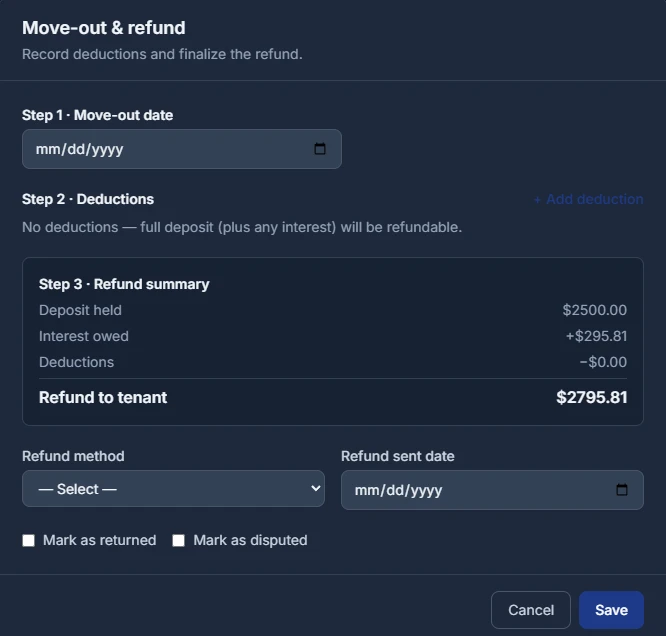
- The move-out reconciliation: itemized deductions with receipts, refund amount, and date sent (with delivery proof).
This belongs in the same system you use to track rent payments and handle late rent. Keeping everything for one tenant in one place is what makes the year-end reconciliation, and any future court case, manageable. PropertyLens does this automatically: deposits are tracked alongside the lease, interest accrues based on your state's rules, and the move-out statement generates from the move-in inspection record.
What should you do next?
If you take only three actions from this guide:
- Look up your state's specific deposit limit, return deadline, and interest rule. Write them down. Don't rely on memory.
- Open a separate "Security Deposits" bank account for your portfolio if you don't have one. Move existing deposits into it this week.
- Build a move-in inspection process with photos and a signed checklist for every new tenant. This is the single highest-ROI process change a landlord can make.
The security deposit is the part of being a landlord most likely to put you in court. Treat it like a fiduciary obligation, because in most states, that's exactly what it is.
Ready to stop juggling spreadsheets?
PropertyLens tracks rent, manages tenants, and handles maintenance — free for your first property.
Start freeFrequently asked questions
How much can a landlord charge for a security deposit?
Most states cap security deposits at 1 to 2 months of rent for unfurnished units, and 2 to 3 months for furnished. About a dozen states have no cap at all. Always check your state's specific limit, because exceeding it can void the deposit entirely and expose you to penalties.
How long do landlords have to return a security deposit?
The return deadline ranges from 14 days (Vermont) to 60 days (Arkansas, Maryland) after move-out, with most states landing at 21 to 30 days. The clock typically starts on the date of move-out, not the lease end date. Missing the deadline almost always forfeits the entire deposit, even if there's legitimate damage.
Do landlords have to pay interest on security deposits?
About 16 states require interest on security deposits, including New York, New Jersey, Massachusetts, Illinois, Maryland, Connecticut, Florida (under specific conditions), and most of New England. The rate varies. Sometimes it's a fixed annual percentage, sometimes it's tied to the bank's actual rate. Interest is typically owed to the tenant annually or at move-out.
What can a landlord legally deduct from a security deposit?
Three categories are universally allowed: (1) unpaid rent, (2) damage beyond normal wear and tear, and (3) cleaning costs to return the unit to its pre-tenancy condition. What you cannot deduct: normal wear, pre-existing damage, repairs that improve rather than restore, or anything not documented with receipts and a written statement.
What is normal wear and tear vs damage?
Normal wear is what happens with reasonable use over time: minor carpet wear in walkways, small nail holes from hung pictures, faded paint, slight scuffs on walls. Damage is anything beyond that: stained carpet, large holes in drywall, broken fixtures, pet damage. The dividing line is whether a careful tenant could have prevented it. Courts side with tenants when this is ambiguous.
What happens if a landlord doesn't follow security deposit law?
Penalties vary by state but commonly include: forfeiting the entire deposit, paying 2x or 3x the deposit as statutory damages, and covering the tenant's attorney fees. Some states also impose criminal penalties for willful violations. The most common landlord loss in small claims court is a security deposit case where the landlord followed the wrong deadline.