How to Handle Late Rent (Without the Stress)
Late rent is going to happen. The landlords who handle it well aren't the ones with the toughest tenants — they're the ones with the clearest process.
Late rent is the part of being a landlord that keeps people up at night. Not because of the money — usually the money shows up — but because of the uncertainty. Should I send another text? Is it too soon to charge a late fee? Am I being a pushover or am I about to lose a good tenant?
The fix is a process. Not a hardline policy, not a soft-touch policy — a sequence of specific actions tied to specific dates that you follow every time, regardless of which tenant is late. Once you have that, late rent stops being stressful and starts being an admin task.
Why does late rent feel so stressful for landlords?
Three things make late rent harder than it needs to be for most independent landlords:
- You're improvising. No lease, no schedule, no template. Every late incident is a fresh decision about how aggressive to be.
- You know the tenant personally. Independent landlords almost always do. Sending a "Pay or Quit" notice to someone you had a friendly conversation with last month feels confrontational.
- The legal stakes feel enormous. Eviction sounds like a courtroom drama. Most landlords have never done it, so the whole process feels like one wrong step from disaster.
The remedy for all three is a written process. When you follow a documented schedule, you're not being mean — you're being fair. Every tenant gets the same notice on the same day. The personal stuff stays personal; the rent process stays professional.
What is the right process for handling late rent?
Here is the timeline most professional landlords run. Adjust the day numbers to match your lease's grace period and your state's notice requirements, but keep the structure.
Day 1 past due — friendly reminder
Send a short, warm text or email:
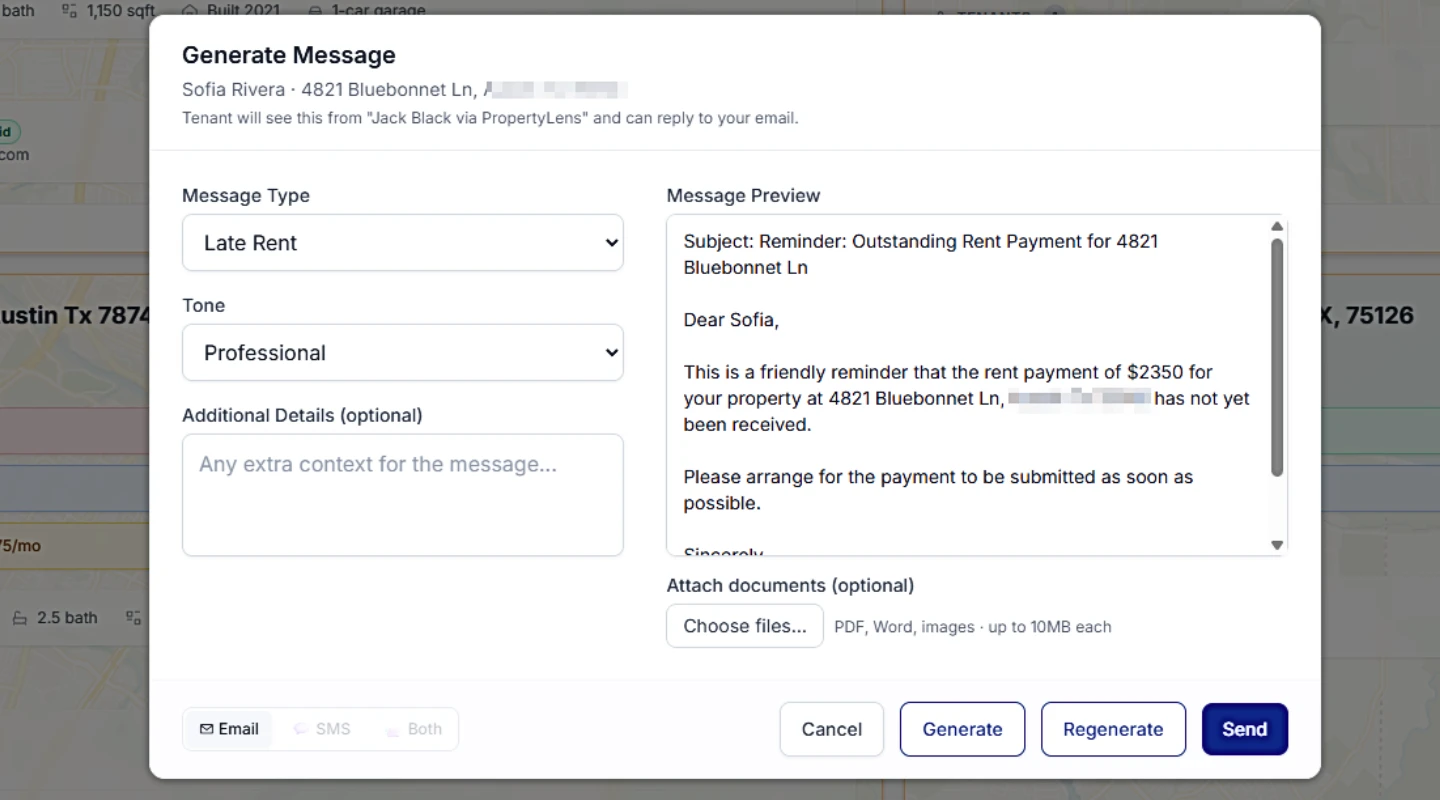
"Hi [Tenant], just a quick note that this month's rent hasn't come through yet. Could you let me know if it's on the way or if there's anything I should know? Thanks!"
This solves the majority of late rent. Bank transfers fail. Autopays get cancelled when cards expire. People legitimately forget. A friendly reminder lets the situation resolve without adversarial framing.
Day 5 — formal late notice + late fee applied
If rent hasn't been paid by the end of the grace period (usually 3–5 days), switch tone. Send a written notice — email is fine in most states, but check your lease — that:
- States the exact amount overdue.
- Applies the late fee per the lease.
- Gives a clear deadline ("Please remit $1,650 plus $50 late fee by April 12").
- Notes the next step if not resolved ("Failure to pay by [date] will result in a formal Pay or Quit notice as required by [state] law").
This is also the moment to log everything in your rent ledger. Late fee, notice sent, method, date. If this ends up in court, this is the day the paper trail starts mattering.
Day 10–14 — Pay or Quit notice
If the tenant hasn't paid or made a payment plan, this is when you send a formal Pay or Quit notice (also called Notice to Pay or Vacate). This is a legal document, not a casual message, and it is the legally required first step before eviction in nearly every state.
The notice period varies by state. Some examples:
| State | Pay or Quit notice period |
|---|---|
| California | 3 days |
| Texas | 3 days |
| Florida | 3 days |
| New York | 14 days |
| Washington | 14 days |
| Massachusetts | 14 days |
This notice must be served correctly — the rules are state-specific (personal delivery, posting on the door, certified mail, etc.). Get this wrong and the eviction case can be dismissed even when the tenant clearly owes the rent.
Important: This is the step where small landlords most often make a procedural mistake. If you've never served a Pay or Quit notice before, use a template from your state's housing authority or a local landlord association — or have an attorney review the first one you send.
Day 30+ — file for eviction or work out a plan
By this point you have two reasonable paths:
Path A — Payment plan. If the tenant communicates and there's a clear path to catching up, a written payment plan is often cheaper for everyone than eviction. Document it in writing, signed by both parties. Specify the catch-up amounts, dates, and what happens if a payment is missed.
Path B — File for eviction. If the tenant is unresponsive or has no realistic ability to catch up, eviction is the path. File the unlawful detainer in your local court. Bring your rent ledger, the lease, the served Pay or Quit notice with proof of service, and a record of all communication.
Eviction takes 4–12 weeks in most jurisdictions, depending on court backlog. Plan for the worst-case timeline so a slow court doesn't become a financial crisis.
What never to do when rent is late
These are the actions that turn a manageable late-rent situation into a lawsuit against you:
- Never change the locks. Self-help eviction is illegal in every state, even if you legally own the property and the tenant owes you money. The penalties can include damages, attorney fees, and — in some states — criminal charges.
- Never remove the tenant's belongings. Same legal category. Same liability.
- Never shut off utilities. Even if the lease says the tenant pays, if you control the account, shutting off heat or water in retaliation for late rent is illegal in essentially every jurisdiction.
- Never threaten eviction without serving the proper notice. Verbal threats can be used against you. Written threats that misrepresent the legal process can be too. Either send a properly formatted notice or don't reference eviction.
- Never accept partial rent during an active eviction proceeding without legal advice. In some states this resets your timeline. In others it doesn't. Don't guess.
- Never get into a public confrontation with the tenant. Save every conversation for written communication where the record is clean.
How do you write a late rent notice?
Here is a template for the day-5 formal notice. This is not a Pay or Quit notice — that has state-specific legal language. This is the in-between step that most issues actually resolve at.
Subject: Overdue Rent — [Property Address] — [Month]
Dear [Tenant Name],
This is a formal notice that rent for [Month, Year] is overdue. As of [Today's Date], the following amounts are unpaid:
- Rent for [Month]: $[Amount]
- Late fee per lease section [X]: $[Amount]
- Total due: $[Total]
Please remit the full amount by [Specific Date — usually 7–10 days from now] via [your preferred payment method].
If payment is not received by [Date], we will be required to issue a formal Pay or Quit notice as required by [State] landlord-tenant law, which may begin the eviction process.
If there's a circumstance affecting your ability to pay, please contact me directly at [phone/email] so we can discuss options.
Sincerely, [Your Name] [Property Management Contact Info]
Keep the tone direct but not personal. The notice is a record, not a conversation.
How do automated rent reminders reduce late rent?
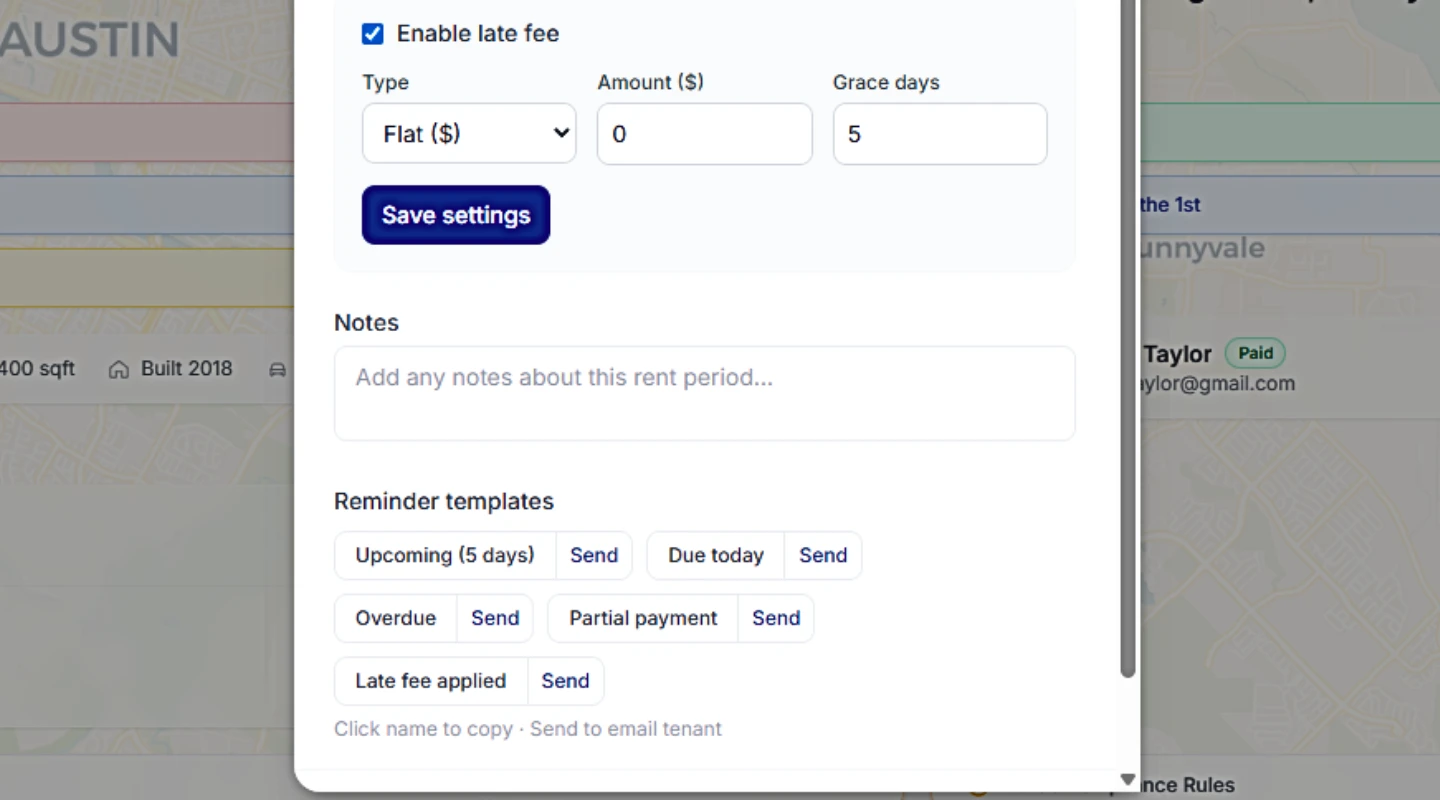
Most late rent is not malicious — it's logistical. Tenants forget, autopays fail, paychecks land on different days. Automated reminders catch most of these before they become problems.
A typical reminder schedule that works:
- 3 days before due — friendly heads-up
- On the due date — payment received confirmation, or a "due today" reminder
- 3 days late — automated late notice with fee applied
- 7 days late — escalation alert to the landlord (not the tenant) flagging the case for human review
PropertyLens runs this schedule automatically based on your lease terms. Reminders go out, late status flips, late fees apply, and the case ends up in your "needs attention" queue at the right moment — without you setting any calendar reminders.
What if the tenant has a real hardship?
This is where independent landlords have an advantage over corporate landlords. You can use judgment.
A tenant who lost a job, had a medical emergency, or hit an unexpected expense is not the same as a tenant who is dodging communication and never pays on time. The former is worth working with. The latter is worth following the process to the end.
Signs a payment plan is worth offering:
- The tenant communicated proactively about the issue.
- The hardship is documented or verifiable (job loss, medical bill).
- The tenant has a track record of on-time payment up to this point.
- There's a clear path to catching up within 60–90 days.
Signs to follow the formal process to its conclusion:
- The tenant stops responding to communication.
- This is the third or fourth late occurrence in 12 months.
- The tenant has refused to sign a written payment plan.
- The arrears are growing month over month.
The process exists so you can make this judgment call without the late-rent timeline pressuring you. By following the day-1 / day-5 / day-10 schedule, you give yourself room to be flexible without falling behind on legal deadlines.
How do I prevent late rent from happening?
Three things measurably reduce late rent in independent portfolios:
- Set up online rent payments. Tenants who can pay in 30 seconds from their phone pay on time more often than tenants who have to mail a check. The friction itself causes late rent.
- Send pre-due reminders. A 3-day-before reminder reduces late rent by a meaningful amount in every landlord study that's measured it. It's the cheapest intervention available.
- Charge the late fee, every time, automatically. Inconsistent enforcement teaches tenants the deadline is negotiable. Consistent enforcement teaches the opposite. The late fee is in the lease; treat it like the law of physics.
A clean rent process — pre-due reminder, easy online payment, automatic late fee on day 5, formal notice on day 10 — eliminates almost all of the late-rent stress without making you the bad guy. The system is the bad guy; you're just the landlord.
If you want this whole process running on autopilot, PropertyLens does it for free on your first property.
Ready to stop juggling spreadsheets?
PropertyLens tracks rent, manages tenants, and handles maintenance — free for your first property.
Start freeFrequently asked questions
How many days late should I wait before contacting the tenant?
Send a friendly reminder on day 1 past the due date. Most late rent is genuinely accidental — a forgotten bank transfer, a paycheck timing issue, an autopay that failed. A quick reminder solves 70% of late rent without escalation.
Can I charge a late fee for late rent?
Yes, in most states, if your lease specifies it. Most states cap late fees at 5–10% of monthly rent and require a grace period (typically 3–5 days). Late fees not in the lease are generally not enforceable. Check your state's specific cap before charging.
What is a Pay or Quit notice?
A Pay or Quit notice (sometimes called a Notice to Pay or Vacate) is a formal legal document giving the tenant a deadline to pay overdue rent or move out. It's a required step before filing for eviction in most states. The required notice period varies by state — typically 3 to 14 days.
Can I refuse partial rent payment?
In most states, yes, but be careful: in some states, accepting partial rent during an active eviction process can reset your legal clock or waive eviction rights. If you're past the late stage and considering eviction, talk to a local attorney before accepting partial payment.
How do I evict a tenant for non-payment?
Eviction for non-payment requires (1) a properly served Pay or Quit notice with the correct state-mandated notice period, (2) the tenant failing to pay or vacate within that window, and (3) filing an unlawful detainer (eviction) lawsuit in court. Self-help eviction (changing locks, removing belongings) is illegal in every state.
Should I report late rent to credit bureaus?
You can, but only through services that comply with the Fair Credit Reporting Act (FCRA). Reporting incorrectly exposes you to liability. Most independent landlords skip this — it rarely changes tenant behavior and adds compliance risk.