How Long Does a Landlord Have to Return a Security Deposit?
Every state gives landlords a hard deadline to return the deposit. Most landlords don't know theirs, and the penalty for missing it by one day is usually the entire deposit.
Disclaimer: This is general information for landlords, not legal advice. Deposit return deadlines vary by state and get amended. Check your state's current statute or a local landlord-tenant attorney before acting on a specific dispute.
A tenant moves out on the 28th. The unit needs paint and a carpet stretch, your handyman is booked for two weeks, and you figure you'll sort out the deposit once the work is quoted. Six weeks later a demand letter arrives, and it isn't asking for the deposit back. It's asking for three times the deposit, plus attorney fees.
This is the most common way landlords lose money on a security deposit: not by deducting the wrong things, but by being late. The deadline is a hard date set by statute, and in most states a legitimate deduction does not survive a missed deadline.
This post covers one question in depth: how long you actually have, when the clock starts, and what to do when you can't have final numbers in time. For deposit limits, interest rules, and what you can deduct, see the full state-by-state security deposit guide.
How long do you actually have?
Between 14 and 60 days after move-out, depending on the state. The distribution looks like this:
| Deadline | Example states |
|---|---|
| 14 days | Vermont, Hawaii, New York (most tenancies) |
| 15 days | Arizona, Florida (if no deductions) |
| 20–21 days | California, Connecticut, Washington, Wisconsin, Delaware |
| 30 days | The largest group: Texas, Illinois, Massachusetts, Pennsylvania, Virginia, Georgia, Colorado |
| 45 days | New Jersey, Indiana |
| 60 days | Arkansas, Maryland, Tennessee, Alabama |
Three things to know about this table:
- Some states run two clocks. Florida is the well-known one: 15 days to return the deposit if you deduct nothing, but if you intend to deduct, you must send a notice of intent within 30 days, after which the tenant has 15 days to object. [VERIFY: Florida's split deadline before relying on it; the statute has specific notice language requirements.]
- Some deadlines shift with circumstances. A few states give a longer window if the lease says so, or a shorter one if the tenant requests an early inspection.
- These get amended. New York's deadline dropped from 30-ish custom practice to 14 days by statute in 2019, and plenty of landlords found out in court. Whatever you memorized when you bought the property may be stale.
The practical rule: know your state's number cold, and treat it as a few days shorter than it is. Mail time counts against you in most states only at the margins, but "I mailed it on day 30" with a postmark of day 32 is a losing argument you don't need to have.
When does the clock actually start?
This is where careful landlords get caught. The deadline almost never runs from the lease end date. It runs from the date the tenant surrenders possession: vacated the unit and returned the keys.
The cases that trip people up:
- Early move-out. Tenant's lease runs through June 30, but they hand you keys on June 12. In most states your clock started June 12, even though rent is owed through the 30th.
- Late stay-over. Tenant lingers past lease end. The clock starts when they actually leave, not when they should have.
- Eviction. The clock typically starts when you legally regain possession (the lockout date), not when the judgment was entered.
- Abandonment. The murkiest one. If a tenant disappears mid-lease, the clock generally starts when you take possession back. Document that date deliberately: written abandonment notice, dated photos, lock-change receipt. If the start date is ever disputed, you want paper, not memory.
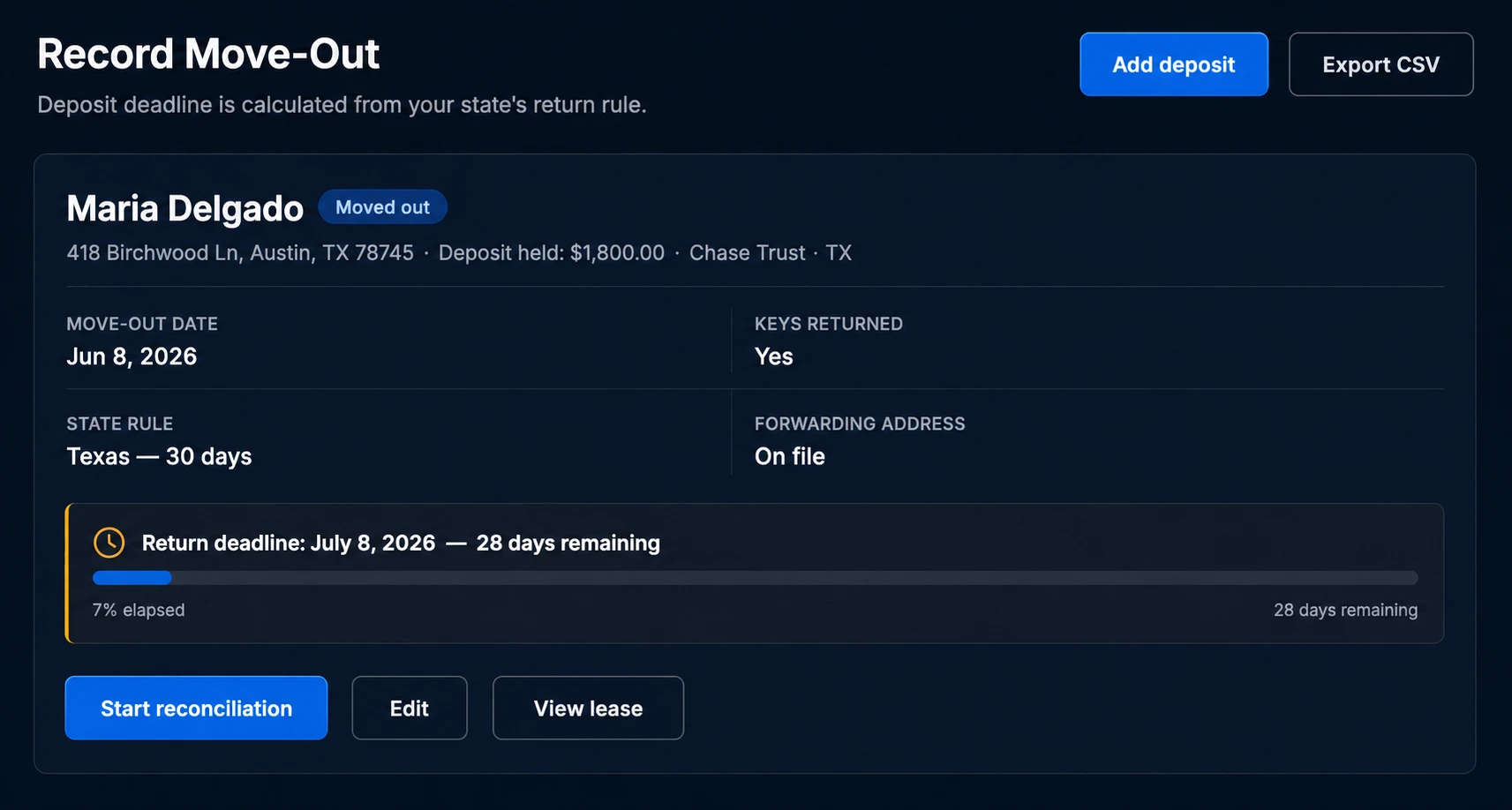
If you take one operational habit from this post: the day keys come back, create the deadline. Put the return date in your calendar, your task list, and your property records before you do anything else with that unit. Turnovers are chaotic, and the deadline doesn't care.
What exactly is due by the deadline?
Not just the money. By the deadline, the tenant must receive (or have had sent to them, depending on the state):
- The refund for whatever portion you're returning, and
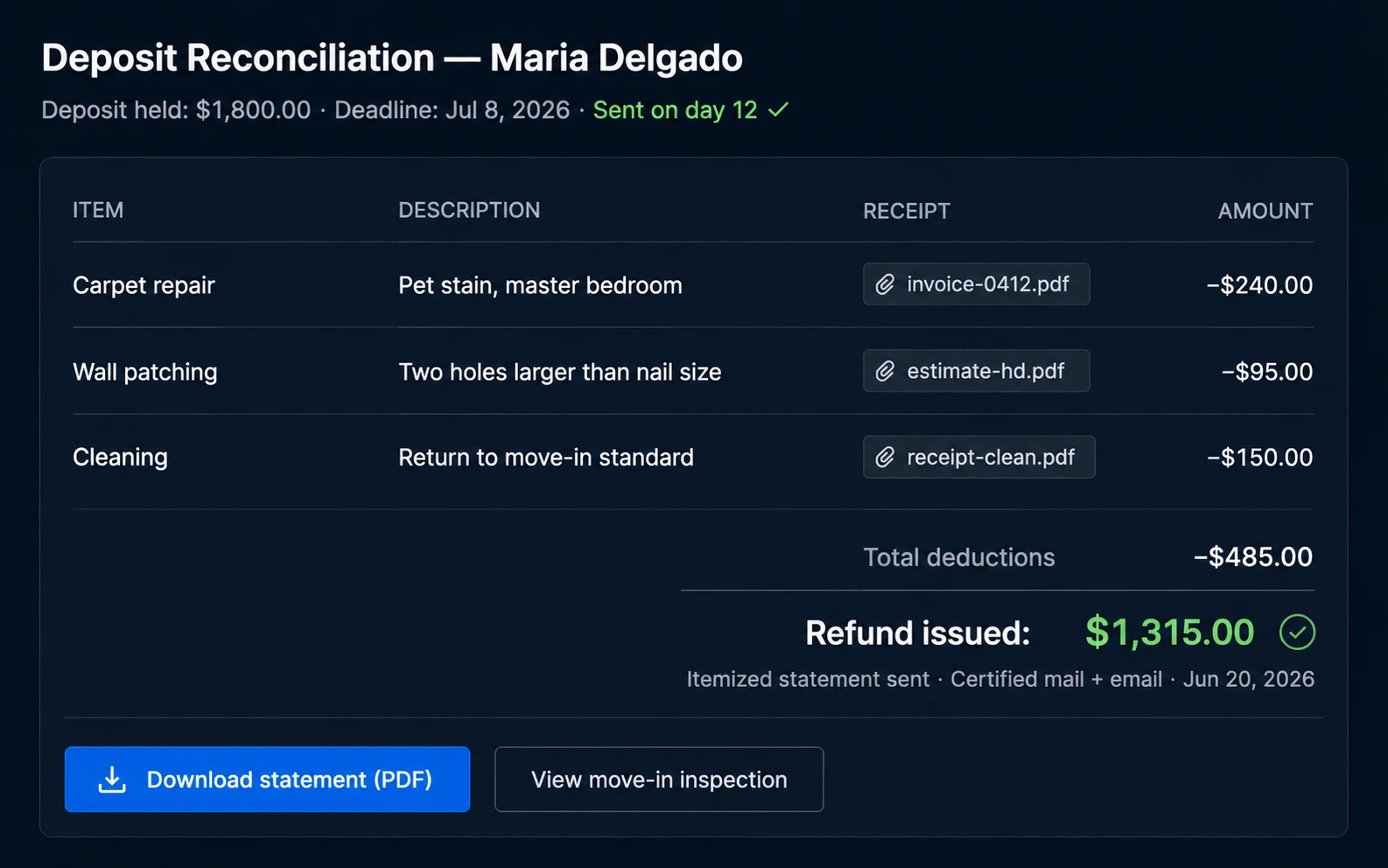
- An itemized written statement for anything you withheld: each deduction on its own line, what it was for, and what it cost, with receipts or estimates in most states.
There's no extra time for the paperwork. A check on day 20 followed by an itemization on day 40 fails in most states just as hard as sending nothing. Courts in many jurisdictions treat a refund without the required itemization as noncompliance, which means full forfeiture even though you technically sent money.
Delivery method matters too. Several states require first-class mail to the tenant's last known address; some require certified mail for the itemized statement. A text message saying "kept $400 for the carpet, Venmo'd the rest" is not an itemized statement anywhere.
Two habits make this painless:
- Collect a forwarding address in writing at move-out. Put a line for it on the move-out inspection form. In most states a missing forwarding address does not pause your deadline; you just have to send to the last known address, which can be the unit itself.
- Send the statement by both email and certified mail. The certified copy is the one that counts in court; the email is the one the tenant actually reads. The combined cost is about $5 against the entire deposit.
What if you can't get repair estimates in time?
The legitimate hard case: real damage, a contractor who can't quote it for three weeks, and a 21-day deadline. You cannot just wait. Your options, roughly in order:
- Send a partial refund plus a good-faith estimate. Many states explicitly allow deductions based on written estimates rather than final invoices, trued up later. An itemized statement with "carpet replacement, estimate attached: $850" beats silence in every jurisdiction.
- Use your state's follow-up window if it has one. Some states allow a notice within the deadline stating that final itemization follows within a defined period. This is state-specific; don't assume yours has it.
- When in doubt, refund more and pursue the difference separately. If you genuinely cannot document a deduction in time, returning the deposit and taking the damage claim to small claims court keeps you compliant. It feels backwards. It's far cheaper than 3x damages.
What is never an option is the thing landlords most often do: holding the full deposit past the deadline "until the numbers are in." That converts a strong damage claim into statutory liability.
What does missing the deadline actually cost?
The penalty structure is what makes this deadline different from most business deadlines. Miss it and, in most states:
- You forfeit the entire deposit, including amounts you could have legitimately deducted.
- Many states add 2x or 3x the deposit as statutory damages. California, Massachusetts, Illinois, Connecticut, and Maryland are among them.
- The tenant's attorney fees are commonly recoverable, which is what makes these cases worth filing.
Run the math on a $2,000 deposit with $1,200 of genuine, documented damage in a 3x state. Returned on day 35 instead of day 30, the position flips: instead of the tenant owing you nothing further, you owe $6,000 plus fees, and your $1,200 damage claim becomes a separate small-claims action you have to file and win on your own time.
One missed calendar entry is the difference between those two outcomes. This is why deposit deadlines belong in the same system where you track rent payments: tied to the tenancy record, not to whichever notebook the move-out got scribbled in.
What are the common mistakes and how do you avoid them?
1. Running the clock from the lease end date. The tenant who leaves early shortens your window. Always anchor the deadline to the day possession actually came back.
2. Sending money without the itemized statement. A partial refund with no line-by-line statement is treated as noncompliance in most states. The paperwork is part of the deadline, not an accessory to it.
3. Waiting for perfect repair numbers. Estimates are acceptable almost everywhere; silence is acceptable nowhere. Send the statement with estimates and true it up.
4. No proof of sending. "I mailed it" is an assertion. A certified mail receipt is evidence. If your state requires a specific delivery method, anything else may not count at all.
5. Losing the deadline in turnover chaos. Move-outs come with cleaning, showings, and re-listing. The deadline gets remembered in week five. If your deposit records live in a spreadsheet you open monthly, this will eventually happen to you; it's one of the failure modes covered in managing rentals without spreadsheets.
What should you do next?
Three actions, in order of impact:
- Look up your state's deadline today and write it into your move-out checklist. Not "about a month." The number.
- Make deadline-setting part of key return. The same five minutes that you take the keys, photograph the meter, and sign the move-out inspection is when the return date goes on the calendar.
- Build the itemized statement from the move-in inspection. A deduction is only as strong as the baseline behind it. Date-stamped move-in photos plus receipts at move-out is the whole game.
PropertyLens handles the mechanical parts: when a move-out is recorded, the deposit deadline is calculated from your state's rule, the reconciliation pulls from the move-in inspection record, and the itemized statement generates with receipts attached. But the legal obligation is yours either way, and it starts the day the keys come back.
Ready to stop juggling spreadsheets?
PropertyLens tracks rent, manages tenants, and handles maintenance — free for your first property.
Start freeFrequently asked questions
How long does a landlord have to return a security deposit?
Between 14 and 60 days after move-out, depending on the state. Vermont allows 14 days, California and Washington 21, and the largest group of states (including Texas, Florida, and New York for most situations) sits at 30 days. Arkansas, Maryland, and Tennessee allow up to 60. Check your state's current statute; these get amended.
When does the security deposit return clock start?
In most states, the day the tenant surrenders possession: keys returned and the unit vacated. It is not the lease end date. If a tenant moves out three days early and hands back the keys, the countdown starts that day, not at the end of the month.
What happens if a landlord misses the security deposit deadline?
In most states the landlord forfeits the right to keep any of the deposit, even for legitimate damage. Many states add statutory damages of 2x or 3x the deposit plus the tenant's attorney fees. A missed deadline on a $2,000 deposit in a 3x state means $6,000 owed, before fees.
Does the landlord need the tenant's forwarding address to return the deposit?
You need somewhere to send it, but in most states a missing forwarding address does not pause your deadline. You're typically required to send the refund and itemized statement to the last known address, which can be the rental unit itself. Collect a forwarding address in writing at move-out so this never becomes a question.
Can a landlord send a partial refund while waiting on repair estimates?
Many states allow a partial return plus a written notice that the remaining deductions will be itemized within a short follow-up window, often 14 to 30 more days. The rules are state-specific. What you cannot do anywhere is simply hold the whole deposit past the deadline because a contractor hasn't called back.
Is the deadline different if the tenant is evicted or abandons the unit?
Usually no. Most statutes run the same clock from the date the landlord regains possession, whether by move-out, eviction, or abandonment. Abandonment can make the start date murky, so document the date you took possession back (photos, lock change receipt, written notice) and run your deadline from there.