The Four Ways AI Gets Real Estate Content Wrong
Most agents don't have a prompt problem. They have a verification problem, and more prompts make it worse.
You have probably had this moment. AI drafts a listing description in nine seconds, the copy is clean, the rhythm is good, and then you stop with the cursor over the publish button and think: can I actually send this?
That hesitation is the right instinct, and it is not a prompting problem. This post names the four specific ways AI output goes wrong in real estate, with an example of each, and ends with one rule you can start using today.
It is not a roundup of AI tools. It is what to look for in output you already have.
Why don't agents trust AI output?
A 2026 Realtors Property Resource survey, reported by Real Estate News on 16 February 2026 under the title "82% of Real Estate Agents Use AI: The Real Gap Is Confidence," found that 82% of agents use AI. Fewer than half felt confident putting its output in front of a client. Around 63% cited accuracy worries. Roughly half named compliance and legal risk.
Treat those numbers as directional rather than precise. The sample was small, about 225 agents, so the shape matters more than the decimals: adoption is close to universal, confidence is not. The number one barrier agents named was not enough training. Not a shortage of raw material.
The market responded by selling prompt packs.
Consider what a prompt pack does. It produces more output, faster. If your problem is that you do not trust the output, a tool that produces more of it faster has made your problem bigger, not smaller. What closes the gap is a review habit, and that requires knowing what you are reviewing for.
What is confident fabrication and how do you spot it?
A language model produces the most plausible next words. Plausible is not the same as true, and nothing in the output marks the difference. The confidence is identical whether the model is repeating what you gave it or filling a gap.
In real estate that looks like square footage you never provided, a school assignment that was accurate two boundary revisions ago, HOA dues quoted to the dollar, a "recently renovated" kitchen nobody renovated, and comparable sales that do not exist.
The tell is specificity you did not supply. If you handed the model three bullet points and got back a paragraph containing a year built, a lot size, and a school name, every one of those arrived from somewhere other than you.
So bracket every checkable fact and ask one question of each: was this in what I gave it? If the answer is no, or "I think so," it does not ship until you have the document open.
What is fair housing drift?
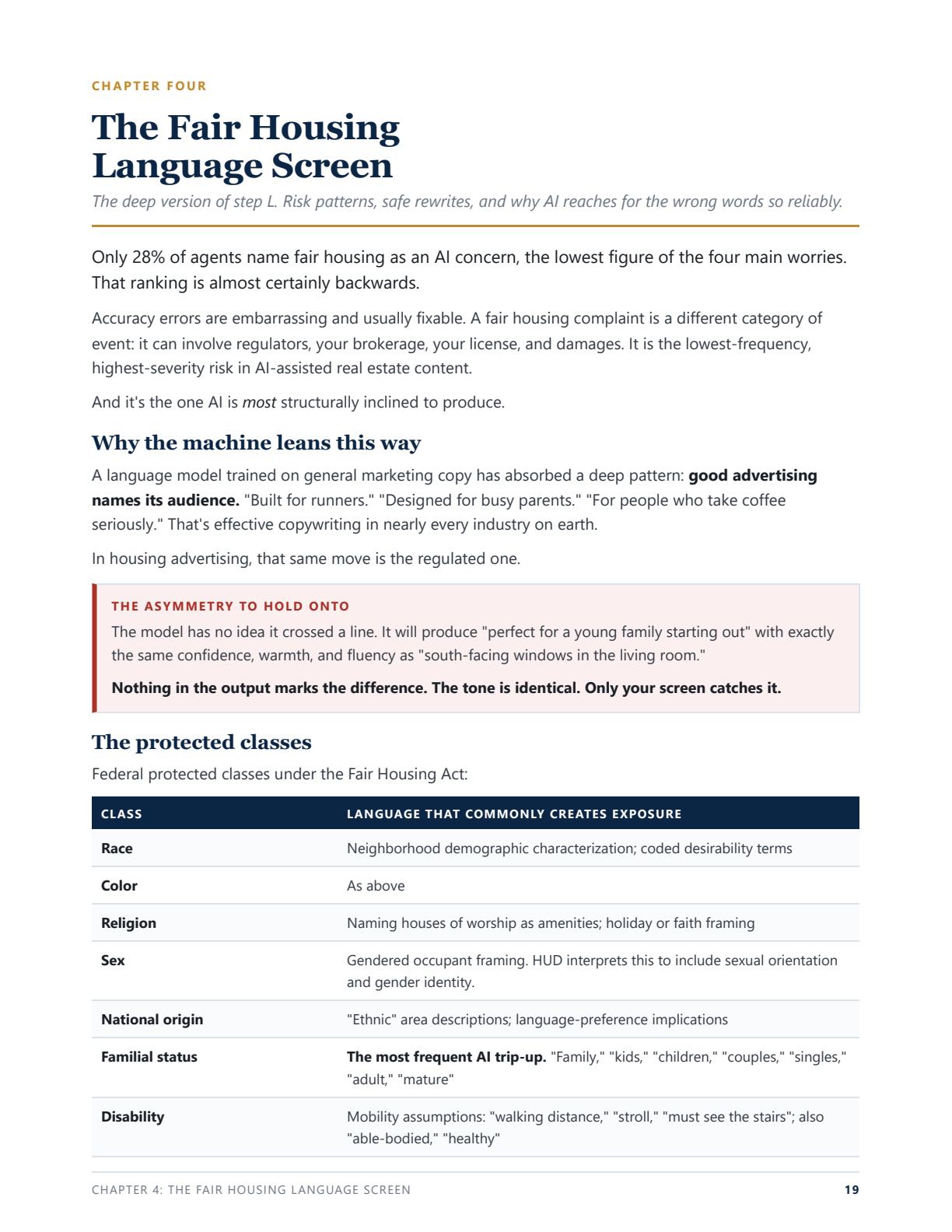
A model trained on general marketing copy has absorbed a pattern that works nearly everywhere else: good advertising names its audience. Built for runners. Designed for busy parents.
In housing advertising, naming your audience is the regulated move.
So the copy slides, one clause at a time, from describing the property to describing who should live in it. "Perfect for a young family." "Ideal for empty nesters." "A safe, quiet street." Each of those describes a person, or implies one, rather than a house.
Here is the part that makes it dangerous. The model has no idea it crossed a line. It writes "perfect for a young family starting out" with exactly the same warmth and fluency as "south facing windows in the living room." Nothing in the tone flags one and not the other.
It is also the risk agents rank lowest. In the same research, only about 28% named fair housing as an AI concern, the smallest of the four main worries. That ranking is close to backwards. Accuracy errors are embarrassing and usually fixable. A fair housing complaint can involve regulators, your brokerage, your license, and damages. Lowest frequency, highest severity, and the one AI is most inclined to produce.
How does AI misread real estate data?
This one is quieter, because every number in the output is correct.
You paste in twelve months of neighborhood sales and ask for a market summary. Back comes "prices in the area rose 8% year over year." Every figure traces to your file. But the 8% came from four closings, two of them new construction with upgrade packages, in a month with unusually low inventory. The arithmetic is right. The conclusion is not.
Statistical reasoning is where these models are weakest, and pricing is where being wrong costs the most. A seller who lists 8% high on a trend that does not exist sits for sixty days and then takes less than they would have accepted on day one.
The discipline here is a division of labor. You do the analysis. AI writes it up. You supply both the numbers and the conclusion, and it supplies the sentences. Never let it near a figure it could invent, and never let it tell you what your own data means.
What are disclosure gaps?
The first three failure modes are about what AI puts in. This one is about what it leaves out.
AI writes what you asked for. It does not know your brokerage's advertising policy, your state's licensing disclosure, your MLS rule on square footage sourcing, or that your market wants an equal housing statement in a particular place. It will not warn you that any of it is missing, because from where the model sits nothing is missing. You got what you requested.
If you also own rentals, this is the same trap that catches landlords with state security deposit rules: the requirement applies whether or not you remembered it existed.
The fix is unglamorous and it works. Write your brokerage's required elements down once, in a plain text file: name and license line, equal housing statement, square footage source, whatever your compliance officer tells you. Check the finished piece against it. A list you actually read beats a rule you half remember.
What is the one rule that catches most of this?
Describe the property, never the buyer.
That single line handles most fair housing drift, and it is more reliable than memorizing banned words, because word lists always miss the next phrase. When something trips the rule, run the substitution test: what physical feature made you want to write that? Write the feature instead.
| Flagged | Rewrite |
|---|---|
| Perfect for a growing family | Four bedrooms, fenced yard |
| Ideal for young professionals | Nine minutes to the light rail |
| Walking distance to shops | 0.3 miles from the Main Street shops |
Each rewrite is shorter, more concrete, and more useful to a buyer than the phrase it replaced. This is the rare compliance rule that also improves the copy. "Four bedrooms, fenced yard" tells a reader something. "Perfect for a growing family" tells them the writer was guessing.
The third row is the one agents miss most. "Walking distance" is not a familial status issue. It is a mobility assumption, and it points at a different protected class entirely.
What are the most common mistakes agents make with AI content?
Five, roughly in the order they cost money:
- Reviewing for tone instead of for facts. The copy reads well, so it gets sent. Reading well is the one thing the model is guaranteed to be good at.
- Assuming the fair housing risk is in obvious words. The obvious ones are easy to catch. The exposure lives in phrases that sound like ordinary, warm marketing.
- Letting AI draw the conclusion from the data instead of only writing up the conclusion you reached.
- Skipping review on anything that feels low stakes. Scale the effort to the stakes, but a social post is public and a client email is discoverable.
- Keeping no record. If a listing is questioned eight months later, you want the final version, the source behind each number, and the date. It is the same habit that makes expense records survive tax season, and the same reason a real system beats a spreadsheet once volume grows.
What should you do next?
Start with the free two pages, because they are the part you can use this afternoon.
The CLEAR Card is a printable checklist for the review pass. The Fair Housing Language Screen is the method behind the rule above, including the substitution test and a longer rewrite table you can tape beside your monitor.
Download the free CLEAR Card and Fair Housing Language Screen
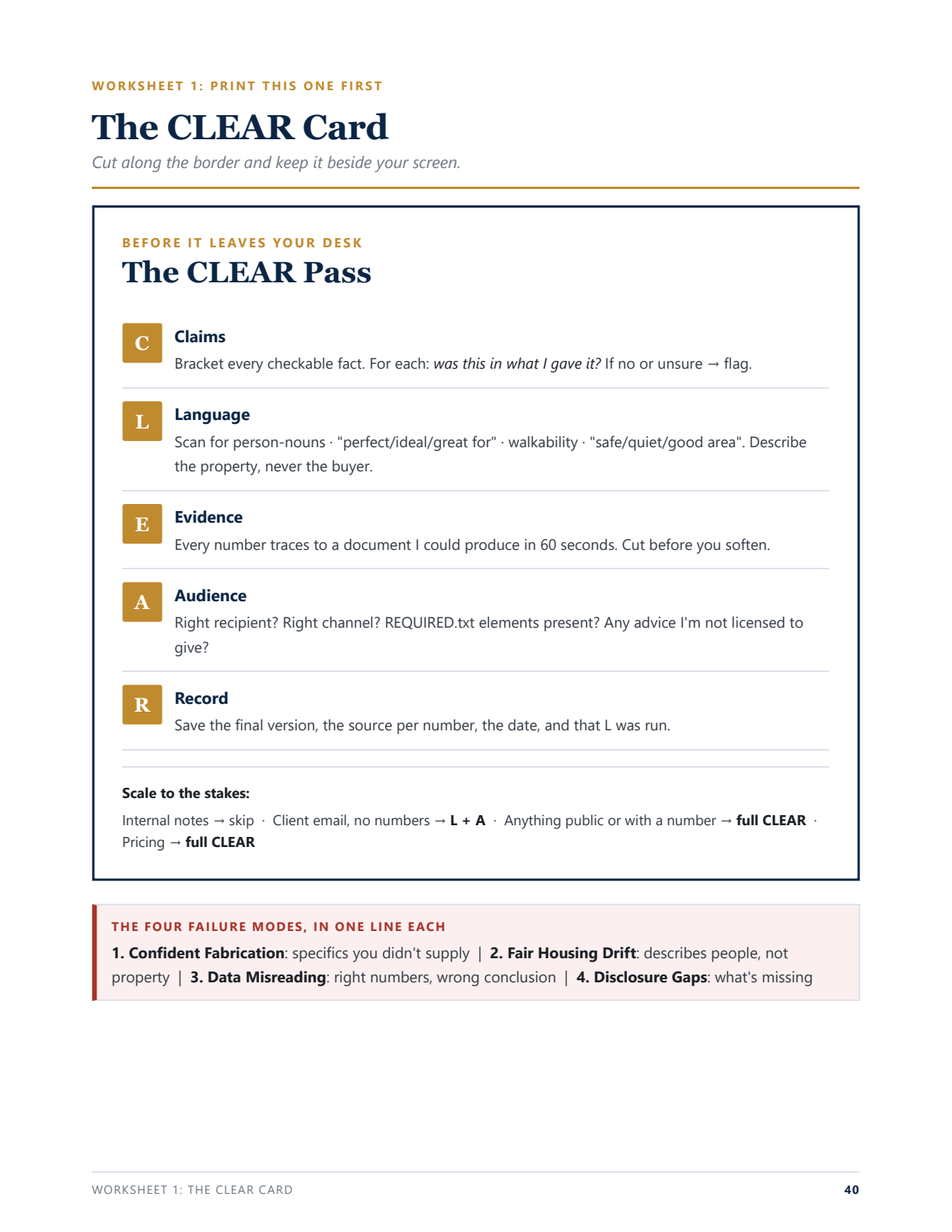
The card came out of a guide. CLEAR is a five step review pass, about a minute per step, that you run on anything before it leaves your desk. Client-Ready AI is 47 pages plus 7 worksheets covering all five steps, the full fair housing screen, the CMA discipline, and a 30 day rollout. It is $47.

Either way, the shift that matters is small. Stop reading AI output to see whether you like it. Start reading it for four specific things, in the same order, every time.
This article is educational and is not legal advice. Fair housing and advertising rules vary by state, MLS and brokerage. Review your process with your broker or compliance officer. You remain responsible for anything you publish.
Ready to stop juggling spreadsheets?
PropertyLens tracks rent, manages tenants, and handles maintenance — free for your first property.
Start freeFrequently asked questions
Can AI write listing descriptions that violate fair housing rules?
Yes, and it does so in a specific way. A model trained on general marketing copy has learned that good advertising names its audience, so it produces phrases like 'perfect for a young family' or 'ideal for empty nesters' with the same fluent tone as any other sentence. Nothing in the output marks it as risky. You have to screen for it.
Does AI make up facts about properties?
Regularly. Square footage, year built, HOA dues, school assignments, and comparable sales are the common ones. The tell is specificity you did not supply: if you gave the model three bullet points and got back a year built and a lot size, those numbers came from somewhere other than you.
Is it safe to use AI for a CMA or pricing narrative?
It is safe to let AI write up an analysis you did. It is not safe to let AI do the analysis. Models are weakest at statistical reasoning and pricing is where being wrong costs the most. Supply both the numbers and the conclusion, and let AI supply the sentences.
Do I have to tell clients that AI wrote my listing description?
There is no blanket federal rule, but disclosure expectations vary by state, MLS, and brokerage, and several have added AI policies since 2024. Ask your broker what your specific obligations are, and remember you remain responsible for the content either way.
What percentage of real estate agents use AI?
A 2026 Realtors Property Resource survey of about 225 agents found 82% use AI in some form, but fewer than half felt confident putting its output in front of a client. Treat those figures as directional given the small sample. The gap between adoption and confidence is the real finding.
How do I check AI content for fair housing problems quickly?
Apply one rule: describe the property, never the buyer. When a phrase describes a person, ask what physical feature made you want to write it, then write that feature instead. 'Perfect for a growing family' becomes 'four bedrooms, fenced yard.'